


Modern Easter celebrations commemorate the death and resurrection of Jesus Christ. Yet the name of the festival, and many of the traditions attached to it, do not come from Scripture.
The English word “Easter” most likely derives from Ēastre, an Anglo-Saxon goddess of spring. The eighth-century historian Bede records that the month named after her lent its name to the Christian festival. Easter eggs and Easter bunnies, both symbols of fertility, are folk customs added later. These have nothing to do with the death and resurrection of Jesus Christ.
Most other languages preserve the true origin. The Greek and Latin Pascha, the French Pâques and the Spanish Pascua all come from Pesach, the Hebrew word for Passover.
The correct setting in which to remember and commemorate His death and resurrection is therefore the Jewish Passover, not the customs of springtime. The New Testament writers make it clear that Jesus Christ is the Passover lamb for the Christian:
Get rid of the old yeast, so that you may be a new unleavened batch—as you really are. For Christ, our Passover lamb, has been sacrificed. Therefore let us keep the Festival, not with the old bread leavened with malice and wickedness, but with the unleavened bread of sincerity and truth. (1 Corinthians 5:7-8 NIV, emphasis added)
The first Passover
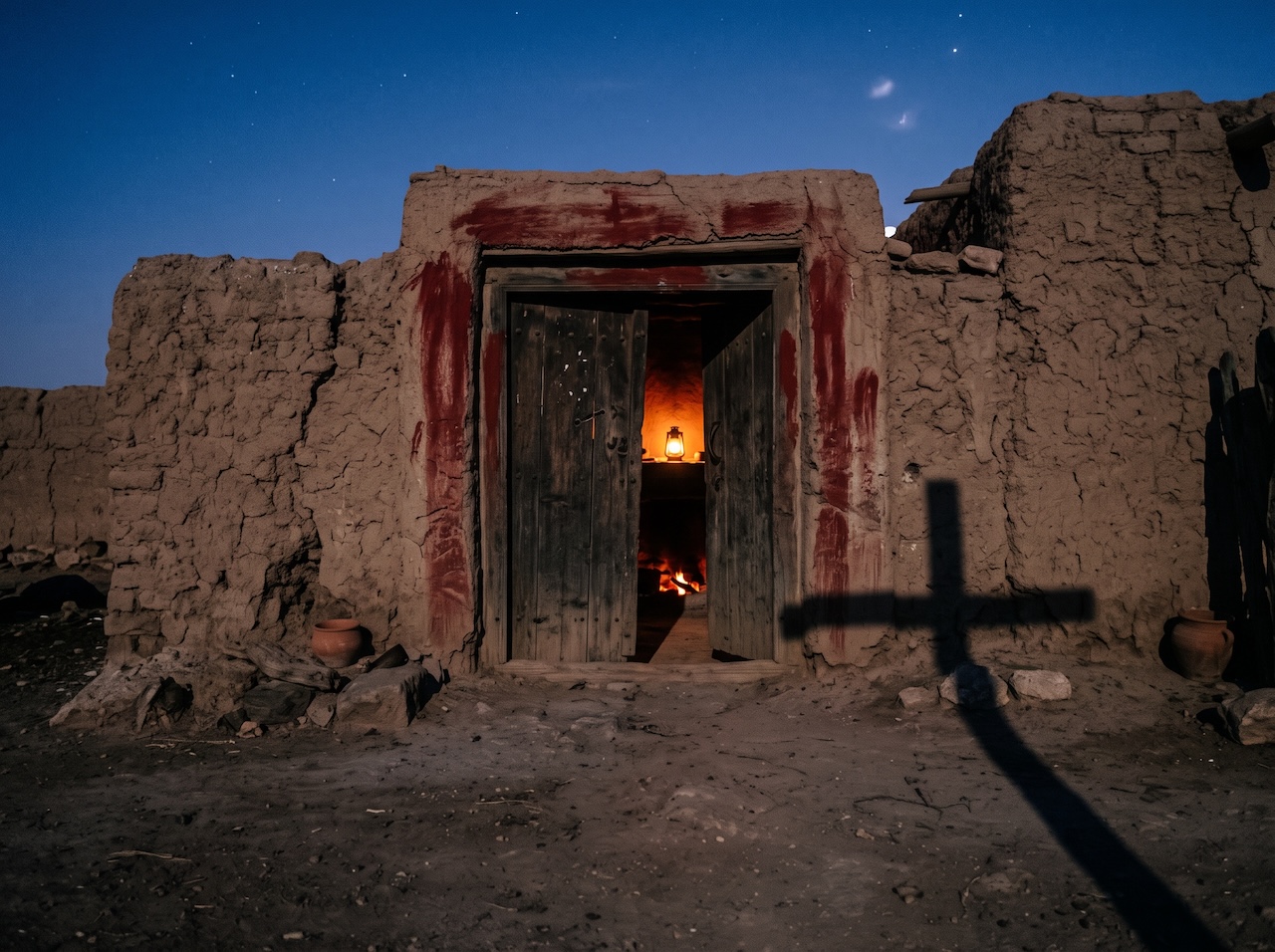
The Jewish Passover was a solemn feast, performed before Israel’s rescue from Egypt. It was taken very seriously: failing to display the blood of the lamb correctly would have meant the death of the firstborn of the household.
Passover is the first of seven feast days in the Jewish calendar year, and it has been commemorated ever since that first night.
The imagery and symbolism connecting the Passover with the sacrifice of Jesus Christ are undeniable. Both events present a sacrificial lamb that protects an individual from the judgement of God and from death. Many details of the Passover “predict”, with remarkable precision, the events of Jesus’ sacrificial death.
Jesus was the ultimate fulfilment of the Passover. This study examines the smaller details of the Jewish Passover and shows how Jesus Christ fulfilled each requirement in a way that could be no accident.
Six requirements of the Passover lamb
Exodus 12 sets out six requirements for the Passover lamb. Each was fulfilled in the death of Jesus Christ.
- Taken from the congregation of Israel (Exodus 12:3). Declared the Lamb of God by John the Baptist (John 1:29, 36).
- Male and without blemish (Exodus 12:5). Found without fault (John 19:6; 1 Peter 1:18-19).
- Kept until the fourteenth day, then killed in the evening (Exodus 12:6). Examined for four days and killed at Passover, at the hour the lambs were slain (John 18:28; 19:14; Matthew 27:45-50).
- Blood on the side posts and upper door post (Exodus 12:7). His blood on the cross, from the crown of thorns and the nails.
- Roasted with fire, and its body eaten (Exodus 12:8-11). Bore the “consuming fire” of God; remembered in communion (Hebrews 12:28-29; 1 Corinthians 11:24-26; John 6:53-54).
- Not a bone broken (Exodus 12:46). His legs were not broken (John 19:31-36).
1. A lamb taken from the congregation of Israel
Tell the whole community of Israel that on the tenth day of this month each man is to take a lamb for his family, one for each household. (Exodus 12:3 NIV)
Jesus qualified directly as a worthy and suitable sacrifice, being of the congregation of Israel. John the Baptist confirmed His credentials:
The next day John saw Jesus coming towards him and said, ‘Look, the Lamb of God, who takes away the sin of the world! (John 1:29 NIV)
When he saw Jesus passing by, he said, ‘Look, the Lamb of God!’ (John 1:36 NIV)
John’s words echo the prophet Isaiah. Seven centuries earlier, Isaiah described the suffering servant as a lamb led to the slaughter, silent before its shearers (Isaiah 53:7).
At the start of Jesus’ ministry, John the Baptist was already preaching repentance of sins and calling people to be baptised, thereby preparing the way for Him. After Jesus’ baptism, John’s ministry effectively came to an end. The arrival of the “lamb” who would take away the sins of the world had been declared.
Incidentally, Jesus “presented” Himself at the temple after His triumphal entry into Jerusalem on the tenth day of the first month, as the verse from Exodus stipulates. Remarkably, Daniel had predicted the precise date of that entry 500 years earlier:
‘Know and understand this: from the time the word goes out to restore and rebuild Jerusalem until the Anointed One, the ruler, comes, there will be seven “sevens”, and sixty-two “sevens”. It will be rebuilt with streets and a trench, but in times of trouble. (Daniel 9:25 NIV)
This permission was given by the Persian ruler Artaxerxes Longimanus in March of 445 BC (see Nehemiah 2:1-9). In precise fulfilment of the prophecy, Jesus presented Himself as the Messiah to the religious leaders in Jerusalem, to be “inspected” until the fourteenth day of the month.
Unfortunately, much like today, the religious leaders no longer took their Scriptures literally, and “missed” Him as a result.
2. A male without blemish
The animals you choose must be year-old males without defect, and you may take them from the sheep or the goats. (Exodus 12:5 NIV)
Jesus obviously qualified as a male. The phrase “of the first year” demonstrates the innocence of the lamb and shows that it was in the “prime” of its life. We are told in many places that Jesus was without blemish, and at the age of 33 He could be described as in the “prime” of His life.
Jesus was also blameless and without sin. He is the only person ever to have lived who could not be accused of any wrongdoing. Even Pontius Pilate, the civil leader of the time, pronounced after examination that Jesus was without fault:
As soon as the chief priests and their officials saw him, they shouted, ‘Crucify! Crucify!’ But Pilate answered, ‘You take him and crucify him. As for me, I find no basis for a charge against him.’ (John 19:6 NIV, emphasis added)
Peter’s epistle uses language that clearly connects Jesus with the Passover lamb:
For you know that it was not with perishable things such as silver or gold that you were redeemed from the empty way of life handed down to you from your ancestors, but with the precious blood of Christ, a lamb without blemish or defect. (1 Peter 1:18-19 NIV, emphasis added)
Jesus therefore fulfilled precisely the condition of being without blemish, and this was confirmed by both the religious and civil authorities of the day.
3. Kept until the fourteenth day of Abib (Nisan), then killed in the evening
Take care of them until the fourteenth day of the month, when all the members of the community of Israel must slaughter them at twilight. (Exodus 12:6 NIV)
All four gospels place the death of Jesus at Passover. John’s gospel is explicit about the timing:
Then the Jewish leaders took Jesus from Caiaphas to the palace of the Roman governor. By now it was early morning, and to avoid ceremonial uncleanness they did not enter the palace, because they wanted to be able to eat the Passover. (John 18:28 NIV)
It was the day of Preparation of the Passover; it was about noon. ‘Here is your king,’ Pilate said to the Jews. (John 19:14 NIV)
The hour of His death is also significant. Jesus died at about the ninth hour, around three in the afternoon (Matthew 27:45-50). The Jewish historian Josephus records that the Passover lambs were slain at the temple from the ninth hour to the eleventh. The Lamb of God died as the lambs of Israel were being killed.
There is more. The lamb was kept for four days before the sacrifice, in the house of the family who would kill it, so that it could be inspected regularly for any blemish.
Jesus “presented” Himself to the religious leaders on the tenth day of the month, after the triumphal entry into Jerusalem. He then appeared at the temple and was “questioned” by the religious leaders on each of the days leading up to His crucifixion on the fourteenth day.
This fulfilled the requirement for the lamb to be questioned and examined for any fault or blemish. None of the religious leaders could find any fault in Him. As noted above, even the civil authority of the day, Pontius Pilate, declared that no fault could be found in Him.
4. Blood on the side posts and the upper door post
Then they are to take some of the blood and put it on the sides and tops of the door-frames of the houses where they eat the lambs. (Exodus 12:7 NIV)
This condition was fulfilled dramatically in the method of Jesus’ execution. The crown of thorns pierced His head, sprinkling blood on the upper post of the wooden cross. The nails sprinkled His blood on the two side posts.
No other method of execution could have fulfilled this condition so precisely.
5. Roasted with fire, and its body eaten
That same night they are to eat the meat roasted over the fire, along with bitter herbs, and bread made without yeast. 9 Do not eat the meat raw or boiled in water, but roast it over a fire—with the head, legs and internal organs. 10 Do not leave any of it till morning; if some is left till morning, you must burn it. 11 This is how you are to eat it: with your cloak tucked into your belt, your sandals on your feet and your staff in your hand. Eat it in haste; it is the Lord’s Passover. (Exodus 12:8-11 NIV)
Roasted with fire. Both the Old and New Testaments describe God as a “consuming fire”. They urge believers to recognise the holiness and justice of God in addition to His unfathomable love, mercy and patience:
Therefore, since we are receiving a kingdom that cannot be shaken, let us be thankful, and so worship God acceptably with reverence and awe, for our ‘God is a consuming fire.’ (Hebrews 12:28-29 NIV, emphasis added)
His body was beaten and scourged beyond recognition. Jesus then experienced the “consuming fire” of God, exclaiming in anguish and agony that He had been “forsaken” by God.
This is a strong connection between the “roasting” of the lamb at Passover and God “consuming” the sins of the world through Jesus Christ.
Its body eaten. Another very strong symbolic picture in the Passover is the eating of the lamb’s body. Many places in the New Testament allude to the fact that communion is strikingly symbolic of the Passover meal:
and when he had given thanks, he broke it and said, ‘This is my body, which is for you; do this in remembrance of me.’ In the same way, after supper he took the cup, saying, ‘This cup is the new covenant in my blood; do this, whenever you drink it, in remembrance of me.’ (1 Corinthians 11:24-25 NIV)
Jesus Himself bears witness that the Christian symbolically takes part in the Passover meal, with the body of Jesus being the Passover lamb:
Jesus said to them, ‘Very truly I tell you, unless you eat the flesh of the Son of Man and drink his blood, you have no life in you. Whoever eats my flesh and drinks my blood has eternal life, and I will raise them up at the last day. (John 6:53-54 NIV)
These words of Jesus sound strange in our cultural setting. Yet the link is impossible to deny. The New Testament speaks of “feeding” on Jesus as the sacrifice for our sins, to protect us from judgement. The Israelites fed on the Passover lamb, which likewise protected them from judgement.
The Passover meal taught the Israelites that without the shedding of blood there was no remission of sins. We can receive forgiveness and avoid eternal punishment only by pointing to the blood of Jesus, shed in our place.
6. Not a bone to be broken
It must be eaten inside the house; take none of the meat outside the house. Do not break any of the bones. (Exodus 12:46 NIV, emphasis added)
This subtle requirement was also fulfilled with remarkable precision. The Roman soldiers were commanded to break the bones of Jesus and the two thieves. Because Jesus was already dead, they did not break His legs:
Now it was the day of Preparation, and the next day was to be a special Sabbath. Because the Jewish leaders did not want the bodies left on the crosses during the Sabbath, they asked Pilate to have the legs broken and the bodies taken down. The soldiers therefore came and broke the legs of the first man who had been crucified with Jesus, and then those of the other. But when they came to Jesus and found that he was already dead, they did not break his legs. Instead, one of the soldiers pierced Jesus’ side with a spear, bringing a sudden flow of blood and water. The man who saw it has given testimony, and his testimony is true. He knows that he tells the truth, and he testifies so that you also may believe. These things happened so that the scripture would be fulfilled: ‘Not one of his bones will be broken,’ (John 19:31–36 NIV)
Jesus could have had no direct control over this condition, and yet it was fulfilled in precise detail.
Surely more than coincidence
The conditions associated with the Passover lamb were fulfilled so precisely in the death of Jesus Christ that, we would suggest, this alone conclusively proves the divine authorship of the gospels. Who could record the life of Jesus Christ whilst contriving to make it fit the conditions of the Passover lamb? This cannot be a coincidence.
This brief study points to a wider truth. Everything in the Old Testament points prophetically forward to Jesus’ death and resurrection, and everything in the New Testament points back to these central events.
We believe it is staggering that an ancient Jewish festival, requiring specific preparations in minute detail that would possibly have made no sense at the time, would be literally replicated in the Passover lamb of mankind.
A Passover open to all
Exodus 12:38 contains a strange phrase, referring to a “mixed multitude”:
And a mixed multitude went up also with them; and flocks, and herds, even very much cattle. (Exodus 12:38 KJV)
This “mixed multitude” demonstrates that some who took part in the first Passover were non-Israelites. It may be a hint that when Jesus performed the role of Passover lamb, Gentiles were included, as the “mixed multitude”, in having their sins “passed over”.
The instructions that follow confirm this. A foreigner who joined himself to Israel through circumcision could keep the Passover, and one law applied to the native-born and the stranger alike (Exodus 12:48-49). The protection of the lamb’s blood was not reserved for Israelites by birth.
Without the shedding of blood
Both the Old and New Testaments consistently teach that our sinful human condition can be dealt with only through the shedding of blood:
For the life of a creature is in the blood, and I have given it to you to make atonement for yourselves on the altar; it is the blood that makes atonement for one’s life. (Leviticus 17:11 NIV)
In fact, the law requires that nearly everything be cleansed with blood, and without the shedding of blood there is no forgiveness. (Hebrews 9:22 NIV)
At the Last Supper, Jesus made it very clear that His own blood was going to be shed for the remission of sins:
This is my blood of the covenant, which is poured out for many for the forgiveness of sins. (Matthew 26:28 NIV)
Very soon after these words, Jesus was killed in a way that perfectly fulfilled the conditions of the Passover lamb. Jesus is OUR Passover lamb.
With the blood of Jesus Christ atoning for our sins, we can be confident that on the final day God’s judgement will “pass over” us. We will be spared from death, just as the Israelites were spared during that first Passover meal.
Every individual remains under the judgement of God without symbolically “displaying” the blood of Jesus by having faith in Him. The result of judgement is death. It resulted in death for those who did not display the blood of the lamb at the time of the Passover, and it will result in death for those who do not point to the blood of Jesus Christ on the day of judgement.
Jesus the “firstfruits”
It is very important to remember that the account of Jesus Christ does not end with His sacrifice on our behalf.
On the day after the first “weekly” Sabbath following the Passover, the Israelites were instructed to take part in the offering of “firstfruits” (Leviticus 23:10-11). This pointed symbolically forward to Jesus’ resurrection from the dead, which demonstrated the complete defeat of sin and death for those in Christ Jesus.
Paul makes this point to the church in Corinth:
But Christ has indeed been raised from the dead, the firstfruits of those who have fallen asleep. For since death came through a man, the resurrection of the dead comes also through a man. For as in Adam all die, so in Christ all will be made alive. But each in turn: Christ, the firstfruits; then, when he comes, those who belong to him. (1 Corinthians 15:20-23, emphasis added)
What else could Jesus Christ have done to demonstrate that He really is Lord of Lords and King of Kings? He not only took it upon Himself to die in our place; He also demonstrated power over sin and death in His resurrection.
What a staggering gift for those who will accept Him!
Read our How to be Saved page to learn how to escape the judgement of God and be ready for the Coming King.