


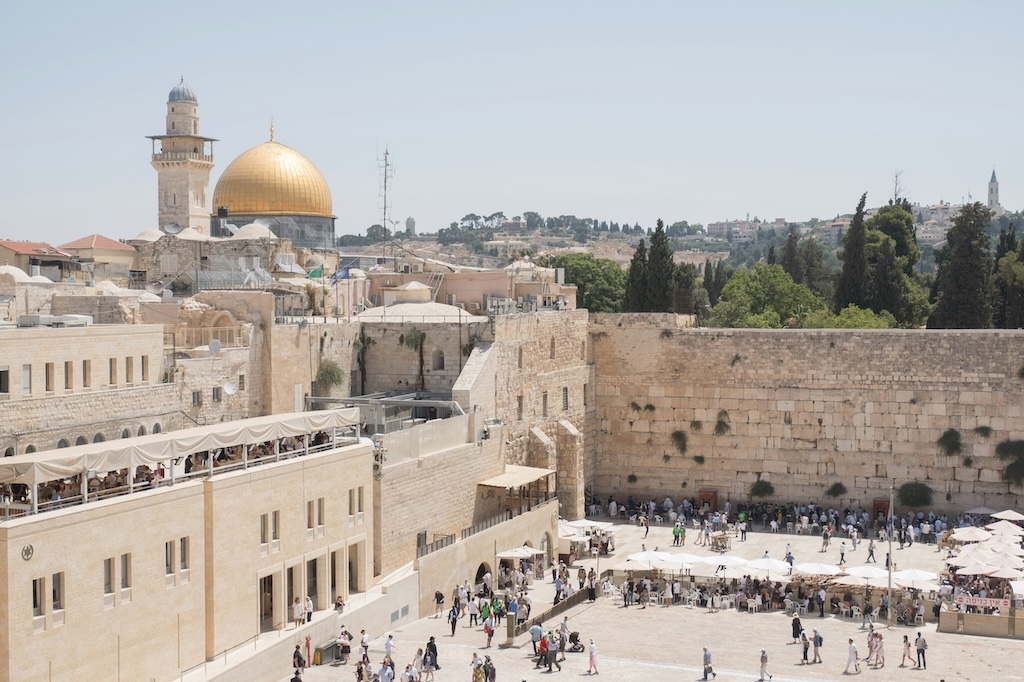
Israel is easy to miss on a map. At roughly 8,000 square miles, it is a fraction of the size of its neighbours – the United Kingdom alone is eleven times larger. It stretches 263 miles from north to south, and narrows to as little as nine miles wide.
So why does this small nation draw so much of the world’s attention?
A crossroads since ancient times
In the ancient world, this small strip of land sat at the meeting point of Asia, Africa and Europe. Jerusalem stood at the centre of it. Israel bridged the Mediterranean to the west and the Syrian-Arabian desert to the east – a narrow corridor connecting the great powers of the ancient Near East.
Anyone travelling to or from Egypt, or moving goods between the Mediterranean and the Gulf of Aqaba, had to pass through it. For centuries, this made the region the crossroads of international trade.

A modern state, against the odds
The modern State of Israel exists against significant historical resistance. On 2 November 1917, Britain issued the Balfour Declaration, backing a national home for the Jewish people. Arab nations opposed it fiercely, even after six million Jews were murdered in the Holocaust.
Israel was finally established on 14 May 1948. But independence did not end the Jewish people’s struggle – in many ways, it intensified it.
Israel remains the only parliamentary democracy in the Middle East, and one of the few places in the region where Arab women have the vote. Jews form the majority, but Arab citizens hold full and equal legal rights. At founding, the population was 806,000. It now stands at over 10 million – around 76% of Jewish background – a number still rising as global Jewish communities return home amid growing persecution elsewhere.
The most fought-over city on earth
Jerusalem has been destroyed twice, besieged 23 times, attacked 52 times, and captured and recaptured 44 times, according to Wikipedia’s history of the city. Few places on earth have been so relentlessly contested.
The hostility hasn’t faded. Surrounding nations remain vocal in their opposition to Israel, and the country faces constant, disproportionate scrutiny from the international community. A few examples illustrate the scale of the threat.
Islamic State
Islamic State terrorised Iraq and Syria, carrying out atrocities that eventually drew US military intervention. IS has signalled intent to expand its reach into neighbouring Arab states – a prospect that puts Lebanon and Jordan on edge. Given its documented campaigns of genocide against Christians and Yazidis, there is little doubt what it would do to Israel if given the opportunity.
Iran
Former President Mahmoud Ahmadinejad regularly called for Israel to be eliminated. His successor, Hassan Rouhani, described Israel as a “festering Zionist tumor.” Supreme Leader Ali Khamenei has gone further still, calling for the annihilation of the Jewish state.
Much of the recent tension between the two nations centres on Iran’s nuclear programme, and whether Israel would act to halt it. Any move by either side would carry consequences far beyond the region.
Hamas
Hamas emerged from Egypt’s Muslim Brotherhood with the stated goal of ending what it calls Israeli “occupation.” It has fired more than 30,000 rockets and mortars into Israel since 2005 – including a renewed barrage following its October 2023 attack on Israel – often from densely populated civilian areas, using its own people as human shields to provoke retaliation.
Hezbollah
Hezbollah, a Shi’a militant group based in Lebanon and backed by Iran, has claimed to hold tens of thousands of rockets aimed at Israel, ready to be used should action be taken against Iran.
A wider pattern
These are only the most visible examples. The same hostility shows up more quietly across the world, antisemitic incidents have been rising steadily across Western nations. It’s little wonder many Jewish people see relocating to Israel as their safest option.
Why does Israel attract so much hostility?
The Bible offers a direct answer: Israel is God’s chosen land, and the Jewish people are His chosen nation. History bears this out – they have survived millennia of sustained aggression, as a nation and in exile alike. Any nation hostile to the God of the Bible tends, in time, to become hostile to Israel.
Scripture describes Israel as chosen “out of all the peoples on the face of the earth”:
For you are a people holy to the LORD your God. The LORD your God has chosen you out of all the peoples on the face of the earth to be his people, his treasured possession. (Deuteronomy 7:6 NIV)
A status confirmed again:
you his servants, the descendants of Israel, his chosen ones, the children of Jacob. (1 Chronicles 16:13 NIV, emphasis added)
This status was sealed through binding, everlasting covenants. In Genesis 17, God renames Abram as Abraham and promises him the land of Canaan “as an everlasting possession” for his descendants.
When Abram was ninety-nine years old, the LORD appeared to him and said, “I am God Almighty; walk before me faithfully and be blameless. Then I will make my covenant between me and you and will greatly increase your numbers.” Abram fell facedown, and God said to him, “As for me, this is my covenant with you: You will be the father of many nations. No longer will you be called Abram; your name will be Abraham, for I have made you a father of many nations. I will make you very fruitful; I will make nations of you, and kings will come from you. I will establish my covenant as an everlasting covenant between me and you and your descendants after you for the generations to come, to be your God and the God of your descendants after you. The whole land of Canaan, where you now reside as a foreigner, I will give as an everlasting possession to you and your descendants after you; and I will be their God.” (Genesis 17:1-8 NIV)
Psalm 105 confirms the same promise was later renewed with Isaac and Jacob.
He remembers his covenant forever, the promise he made, for a thousand generations, the covenant he made with Abraham, the oath he swore to Isaac. He confirmed it to Jacob as a decree, to Israel as an everlasting covenant: “To you, I will give the land of Canaan as the portion you will inherit.” (Psalm 105:8-11 NIV)
The covenant concerned a literal, physical territory – not a metaphor – and its fulfilment was never made conditional on Israel’s behaviour. Even the disciples understood this: moments before Jesus ascended, they asked whether He was about to restore the kingdom to Israel. He didn’t correct the premise, only the timing.
Then they gathered around him and asked him, “Lord, are you at this time going to restore the kingdom to Israel?” He said to them: “It is not for you to know the times or dates the Father has set by his own authority. (Acts 1:6-7 NIV)
God has promised repeatedly to regather His people to this land. Ezekiel 37 and Amos 9 both describe a future, permanent return.
‘This is what the Sovereign LORD says: I will take the Israelites out of the nations where they have gone. I will gather them from all around and bring them back into their own land. I will make them one nation in the land, on the mountains of Israel. There will be one king over all of them and they will never again be two nations or be divided into two kingdoms. (Ezekiel 37:21-22 NIV)
and I will bring my people Israel back from exile. “They will rebuild the ruined cities and live in them. They will plant vineyards and drink their wine; they will make gardens and eat their fruit. I will plant Israel in their own land, never again to be uprooted from the land I have given them,” says the LORD your God. (Amos 9:14-15 NIV)
Notably, the land specified in the original covenant – from the Nile to the Euphrates – is significantly larger than the modern State of Israel. Scripture points to a day when the remaining territory will also be restored.
On that day the LORD made a covenant with Abram and said, “To your descendants, I give this land, from the Wadi of Egypt to the great river, the Euphrates– (Genesis 15:18 NIV)

A spiritual dimension
Beyond politics, there is a spiritual battle behind the world’s hostility toward Israel. Scripture speaks of a future moment when the Jewish people will recognise Jesus as their Messiah (Zechariah 12:10), and much of the opposition to Israel can be understood as an attempt to prevent that prophecy from being fulfilled.
And I will pour out on the house of David and the inhabitants of Jerusalem a spirit of grace and supplication. They will look on me, the one they have pierced, and they will mourn for him as one mourns for an only child, and grieve bitterly for him as one grieves for a firstborn son. (Zechariah 12:10 NIV)
Since the covenant with Abraham, there has been a persistent effort to remove the Jewish people from their land and, at times, to destroy them entirely. Because the regathering of Israel is so closely tied to end-times prophecy, this opposition has only intensified as that regathering has taken place.
God’s prophetic clock
Israel’s national story doubles as a kind of prophetic timeline. The current, ongoing return of Jewish people to the land – long foretold in Scripture – signals how far along we are in God’s plan. Political developments in the region increasingly resemble the conditions Scripture describes for the end times. (Our article on whether we’re living in the end times explores this further.)
For His name’s sake
Ezekiel 36 gives perhaps the clearest statement of why God will restore Israel: not because of Israel’s own righteousness, but for the sake of His own name and reputation. God intends to prove, publicly and unmistakably, that He keeps every promise He makes, so that His word can be trusted completely.
Therefore say to the Israelites, ‘This is what the Sovereign LORD says: It is not for your sake, people of Israel, that I am going to do these things, but for the sake of my holy name, which you have profaned among the nations where you have gone. I will show the holiness of my great name, which has been profaned among the nations, the name you have profaned among them. Then the nations will know that I am the LORD, declares the Sovereign LORD, when I am proved holy through you before their eyes. ‘For I will take you out of the nations; I will gather you from all the countries and bring you back into your own land. (Ezekiel 36:22-24 NIV)
Israel is blessed!
Israel was founded in 1948 as a barren country, short on water and natural resources, with more than half its land desert. Today it’s a global leader in technology and medical research, contributing disproportionately to breakthroughs in health, agriculture and environmental science. Of the roughly 1,000 individual Nobel laureates in history, around 220 have been Jewish – some 22% of all recipients, from a group that makes up just 0.2% of the world’s population.
A few more figures worth noting:
Israel now has the fourth-highest life expectancy among OECD nations, at 83.8 years – behind only Japan, Switzerland and Spain. Around half of Israeli adults aged 25-64 hold a tertiary degree, among the highest rates in the OECD, and the country produces more scientific papers per capita than any other nation. Its fertility rate, at roughly 2.89 children per woman, is the highest in the OECD by a wide margin – a striking outlier among developed economies, most of which sit well below replacement level.
Surviving against the odds
Since its founding, Israel has fought off three major wars – each one, on paper, unwinnable.
1948 – War of Independence. On the day of independence, Egypt, Lebanon, Syria and Iraq attacked simultaneously. Israel’s army numbered just 100,000. Despite the odds, Israeli forces held the offensive and secured victory, at a cost of 6,000 lives – roughly 1% of the population.
1967 – Six-Day War. Facing a combined Arab force of 328,000 troops, more than double its tank count, and superior air power, Israel struck first rather than wait to be attacked. Within days, the air forces of Egypt, Jordan, Syria and Iraq were destroyed, the Golan Heights captured, and the West Bank cleared. Israel emerged having more than tripled its territory and unified Jerusalem.
1973 – Yom Kippur War. Egypt and Syria launched a surprise attack on Judaism’s holiest day, catching Israel off guard – outnumbered as much as 160 to 1 in parts of the Sinai. Israel absorbed the initial losses, then recovered and pushed forward on both fronts before a UN-brokered ceasefire ended the war on 24 October.
In each case, the numbers alone suggested Israel shouldn’t have survived. Many see that as more than good fortune.
What is Israel’s future?
Israel’s ultimate future is a glorious one. Scripture describes it taking centre stage in the Millennial Kingdom under Christ’s reign. Until then, the road remains difficult, as the Jewish people continue returning to their land while end-times events unfold.
Two major battles remain unfulfilled in Bible prophecy:
Psalm 83 describes a coordinated attack by Israel’s immediate neighbours – in modern terms, Jordan, Lebanon (Hezbollah), Gaza (Hamas), Syria, and parts of Turkey and Iraq. Scripture describes Israel’s own forces defeating this coalition.
Ezekiel 38 describes a later, larger invasion – involving modern-day Russia, Turkey, Iran, and several North African nations – that requires Israel to first be dwelling “safely, without walls.” This isn’t the case today, but some see the Psalm 83 conflict as the event that could set those conditions in place. In this battle, Scripture describes God Himself intervening directly to defend the land.
A call to stand with Israel
The Jewish people today live largely in unbelief, and face difficult times ahead. Their leaders, like any nation’s, make mistakes. And yet the scale of hostility directed at Israel – from neighbouring states, international bodies, media, and advocacy groups alike – is wildly disproportionate to anything else in the world.
For believers, this matters. Scripture calls Israel the apple of God’s eye (Zechariah 2:8), and many understand passages like Matthew 25:31-46 to mean we will be held accountable for how we treated the Jewish people. God’s promise to Abraham still stands:
The LORD had said to Abram, “Go from your country, your people and your father’s household to the land I will show you. “I will make you into a great nation, and I will bless you; I will make your name great, and you will be a blessing. I will bless those who bless you, and whoever curses you I will curse; and all peoples on earth will be blessed through you.” (Genesis 12:1-3 NIV)
It’s worth asking: when you stand before God, will you be able to say you were a blessing to Israel?
God’s commitment to Israel’s future is unconditional and permanent. As Jeremiah 31 puts it – as long as the sun, moon and stars remain fixed in the sky, so will the nation of Israel.
This is what the LORD says, he who appoints the sun to shine by day, who decrees the moon and stars to shine by night, who stirs up the sea so that its waves roar–the LORD Almighty is his name: “Only if these decrees vanish from my sight,” declares the LORD, “will Israel ever cease being a nation before me.” This is what the LORD says: “Only if the heavens above can be measured and the foundations of the earth below be searched out will I reject all the descendants of Israel because of all they have done,” declares the LORD. (Jeremiah 31:35-37 NIV)