


One of the most common objections raised against Christians is that the Bible is unreliable, or that it has been corrupted over time. If true, this would be a serious problem. The Christian faith rests on the historicity of the events the Bible describes.
So the question deserves real attention. It should be a priority for anyone genuinely interested in the life of Jesus Christ and it’s worth having some good answers ready for honest conversations with those who ask.
As with most things, someone determined to disbelieve will usually find a reason to. This article is for those who are genuinely open to the evidence.
The Bible makes a striking claim about itself: that it is “God-breathed.”
All Scripture is God-breathed and is useful for teaching, rebuking, correcting and training in righteousness, (2 Timothy 3:16 NIV)
Taken at face value, that means if Scripture could be shown to be unreliable or riddled with contradictions, it would call God’s own integrity into question. We’re talking here about the original texts, as written or dictated by their authors. Errors can creep in through translation but did the Bible, as originally given, accurately record real events and real messages?
This article won’t attempt to catalogue every piece of evidence, that would take a book. Instead, it offers a summary, with links to further reading and viewing. We hope to show that there’s strong reason to trust the Bible as God’s true word. Are you willing to take an open-minded look?
Bible prophecy
One of the strongest reasons to trust Scripture is its track record of fulfilled prophecy. Hundreds of prophecies in the Bible have already come true, we cover this in more depth in Can you prove the Bible? This alone is remarkable authentication: it points to an author who exists outside our timeline.
Archaeology
Modern archaeology keeps reinforcing the historical accuracy of the Bible, often in places where scholars had previously doubted it. The evidence, taken as a whole, strongly supports the historicity of both Old and New Testaments.
The Bible has long been mocked as a book of “fairy tales” with no external support. Yet new discoveries keep proving otherwise. Take the Hittites, mentioned in Genesis 23: no record of these people existing outside the Old Testament until 1906, when archaeologists uncovered a vast Hittite archive. Discoveries like this aren’t isolated – again and again, where secular scholarship has doubted a detail in the text, later evidence has confirmed it.
The Dead Sea Scrolls
Hidden for nearly 2,000 years, these manuscripts were discovered in 1947 in caves near the Dead Sea. They include fragments of every book of the Hebrew Bible except Esther, and show that the text’s content has remained intact across centuries. In short: the Old Testament we read today hasn’t been corrupted over time.
- What are the Dead Sea Scrolls and why are they important? (Got Questions)
Sir William Ramsay
This archaeologist set out sceptical of the Bible, especially the Book of Acts, expecting his research to expose it as inaccurate. Instead, a lifetime of study led him to conclude that “Luke is a historian of the first rank” and he found no material inaccuracy in the text. W. Ward Gasque’s paper explores his life and work in more detail: A Survey of His Contribution to the Study of the New Testament.
Further reading:
- Does Archaeology Support the Bible? (Answers In Genesis)
The Old Testament
The Old Testament’s age leads many to assume it must have been corrupted somewhere along the way, even in light of discoveries like the Dead Sea Scrolls.
But as covered above, the archaeological record supports its reliability. We may never find proof for every historical detail, but what we do have makes a compelling case for anyone willing to look honestly at it.
Fulfilled prophecy adds another layer. Hundreds of separate prophecies – including the coming of the Messiah – were written centuries before the events they describe, often in striking detail. Many defy any natural explanation. The only reasonable conclusion is an author who exists outside of time.
Jesus himself affirmed the Old Testament’s authority, referring to it repeatedly throughout his ministry. And since the Dead Sea Scrolls show the manuscripts of his day closely match what we have now, we can trust the text with the same confidence Jesus placed in it. Would he really have relied on an unreliable set of documents?
Further reading:
- Is the Old Testament Reliable? (Answers In Genesis)
The New Testament
The New Testament faces its own accusations: that it’s been copied too many times to stay accurate, or that too much time passed between the events and the written record for errors not to creep in.
But the copying wasn’t done in a straight line, one manuscript from the last. Many copies were taken independently from source manuscripts, which means the text could be, and has been, cross-checked extensively. A single error in one copy wouldn’t spread unchecked through all the others.
Modern “textual criticism” often tries to cast doubt where little is warranted. In fact, we have over 5,300 Greek manuscript copies of the New Testament, verified to more than 99% accuracy – an extraordinary basis for confidence in the text we have today. Stand to Reason covers this well in Is the New Testament Text Reliable? Their video below responds to the claim that we can’t trust the Gospels’ authors:
Early dating of Gospel accounts
For the Gospels to be accurate, their authors needed to have witnessed the events firsthand or recorded them soon after, while eyewitnesses were still available to verify the account.
Luke opens his Gospel with a remarkable statement of intent:
Many have undertaken to draw up an account of the things that have been fulfilled among us, just as they were handed down to us by those who from the first were eyewitnesses and servants of the word. With this in mind, since I myself have carefully investigated everything from the beginning, I too decided to write an orderly account for you, most excellent Theophilus, so that you may know the certainty of the things you have been taught. (Luke 1:1-4 NIV, emphasis added)
That’s not how a book of fairy tales opens. It reads like the introduction to a carefully researched, eyewitness-based record.
Luke also wrote Acts, and its content offers clues about its date, including which major events it doesn’t mention:
- the destruction of the Jerusalem temple (70 AD)
- the siege of Jerusalem (67–70 AD)
- the deaths of Paul, Peter, and James, the brother of Jesus (61–65 AD)
These were hugely significant events. Their absence strongly suggests Acts was written before they happened, placing it at roughly 60 AD, which pushes Luke’s Gospel earlier still.
Luke’s Gospel is itself quoted in two other New Testament books (1 Corinthians 11:23–26 and 1 Timothy 5:17–18). Since we know 1 Corinthians was written early, Luke’s Gospel must already have been treated as Scripture by that point, placing its composition in the early 50s AD. And since Luke draws on Mark, Mark’s Gospel is earlier still.
This Cumulative Case for the Reliability of the Gospels diagram from Cold Case Christianity shows how a detective would approach investigating the Gospels’ reliability.
Taken together, this evidence dates the Gospels remarkably early. Early enough to have been written, or closely informed, by people who were actually there.
Why trust the Gospel account?
Early dating is strong evidence on its own, but it’s not the only reason to trust the Gospels. Cold Case Christianity lists four:
- They were written early enough to be checked by eyewitnesses.
- They’re corroborated more than any other ancient text – by fulfilled prophecy, archaeology, and precise cultural detail.
- Manuscript evidence shows the text hasn’t changed over time.
- The authors had nothing to gain from lying. They weren’t chasing money or power, many suffered for what they wrote.
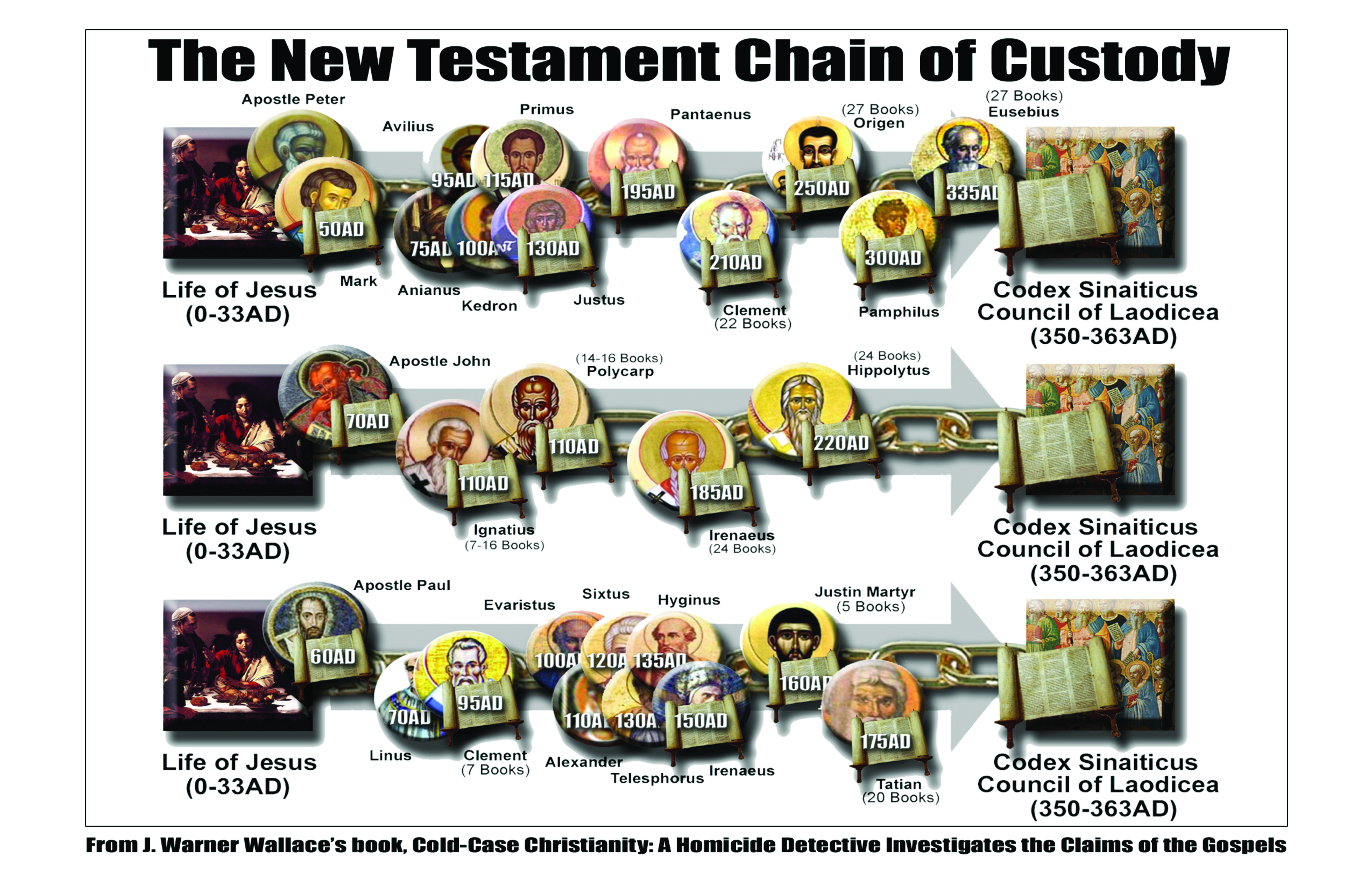
This Chain of Custody diagram, also from Cold Case Christianity, traces how the Gospels and other manuscripts passed from hand to hand in the early centuries, before being recognised as canon. Other writings from that period that reference biblical events show the same consistency, no sign of corruption along the way.
Small details, strong evidence
In this video, Dr. Peter J. Williams presents original evidence that the Gospels were based on eyewitness testimony and shows why the non-canonical gospels don’t hold up to the same scrutiny:
The video highlights small, seemingly unnecessary details scattered through the text, the kind only an eyewitness would think to include. Take this verse:
Then Jesus directed them to have all the people sit down in groups on the green grass. (Mark 6:39 NIV, emphasis added)
Nobody invents the detail that the grass was green. Details like this run throughout the Gospels, and they point to authors who were actually there, not writers working from secondhand accounts decades later.
What about the “contradictions”?
A quick search will turn up long lists of alleged Bible contradictions, and some people treat these as a convenient reason to dismiss Christianity altogether.
But the Bible claims to be God’s word, with real implications for every one of us. Isn’t that worth investigating for yourself, rather than taking someone else’s word for it? Most alleged contradictions have a straightforward explanation, usually rooted in cultural context or chronology that gets missed at first glance. They’re not a good reason to stop investigating, especially given what’s at stake.
Further reading:
- Is the Bible Full of Contradictions? (Stand to Reason)
- Isn’t the Bible Full of Contradictions? (Answers in Genesis)
What about the original manuscripts?
It’s true that none of the original manuscripts survive. But that doesn’t undermine the reliability of the text we have. The earliest originals were written thousands of years ago, no one seriously expects them to have survived intact. Thanks to the meticulous copying methods used by Jewish scribes, we can still trust the accuracy of the text passed down to us. Stand to Reason responds to the objection “we don’t have the original inerrant manuscripts” in the video below:
Why are there so many translations?
There are, without question, a lot of English Bible translations – confusing even for lifelong Christians, let alone newcomers. No translation is perfect, and every one involves some degree of interpretation. Still, the core gospel message comes through consistently across the vast majority of them.
Choosing a translation is largely a matter of personal preference and readability. That said, we’d recommend leaning toward more literal translations over paraphrased ones, and keeping two or three versions on hand to compare.
Note: we don’t consider the Jehovah’s Witness translation (New World Translation) to be a reliable one.
Further reading:
- Which is the best Bible translation? (Got Questions)
- Why So Many Versions? (Bible.org)
- Fifteen Myths about Bible Translation (Daniel B. Wallace)
Conclusion
The evidence, taken together, makes a strong case: the Bible is reliable, and its message has been faithfully passed down to us. The text has stood the test of time.
The gospel message of salvation sits at the centre of Scripture, and it hasn’t changed. God ensured that Jesus Christ’s death and resurrection had eyewitnesses – witnesses whose testimony gives us confidence that our sins have been paid for, and that Jesus Christ is the only way to heaven.
The Bible is God’s message to us. Will you take notice, or keep looking for reasons not to?
But in your hearts revere Christ as Lord. Always be prepared to give an answer to everyone who asks you to give the reason for the hope that you have. But do this with gentleness and respect, (1 Peter 3:15 NIV)
Heaven and earth will pass away, but my words will never pass away. (Luke 21:33 NIV)