


Are the Bible and science compatible? It’s a fair question, and one worth answering carefully.
Many assume that Bible-believing Christians ignore basic observational science in order to accept the Genesis account of creation. But observable, testable and repeatable science isn’t where the disagreement lies. The real dispute is in historical science, the study of origins, where assumptions, shaped by the observer’s worldview, hold a theory together. The trouble starts when those assumptions get presented as fact.
We aren’t scientists, but we value science highly. Still, one question remains: can science alone explain the purpose and significance of the universe it describes? The evidence below is worth considering.
Planet Earth
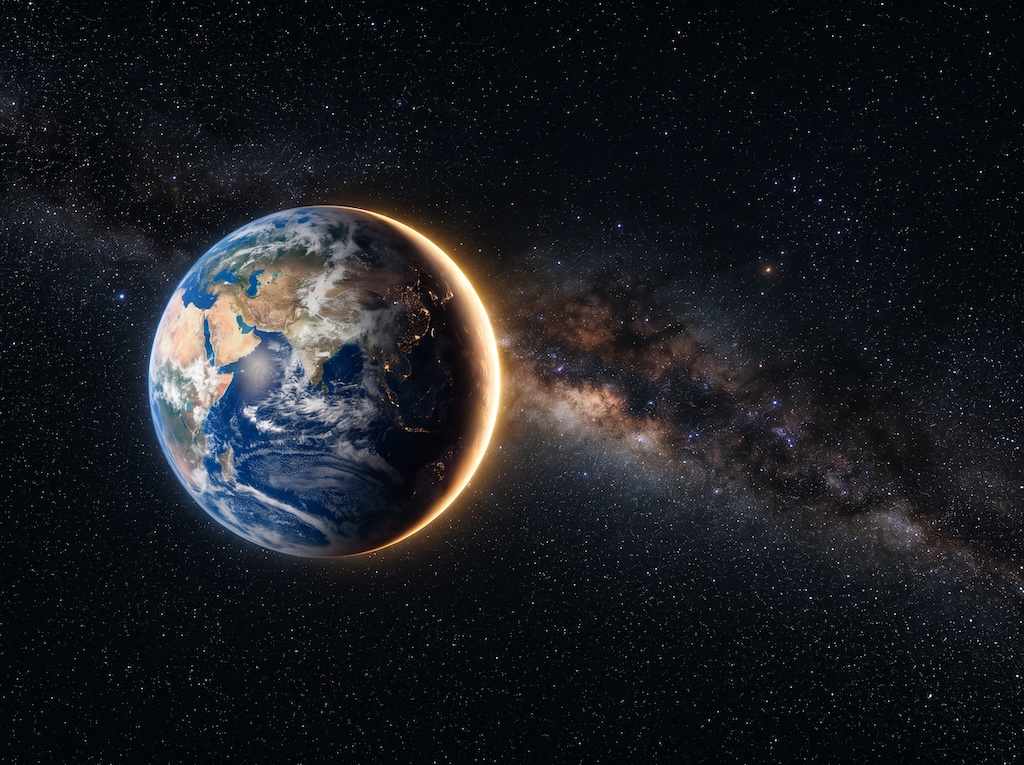
Our understanding of our place in the universe has shifted many times. Copernicus overturned the long-held belief that Earth sat at the centre of everything, showing instead that it orbits the sun. The Hubble telescope later revealed a universe of billions of galaxies, each holding billions of stars. Our own Milky Way contains over 100 million.
Faced with that scale, it’s tempting to agree with Carl Sagan, who called our planet “a lonely speck in the great enveloping cosmic dark.”
But is that the whole story? Is Earth simply an accident, or does its position in the galaxy suggest something more deliberate?
Despite decades of searching, no planet discovered so far comes close to matching Earth’s conditions for life. Scientists have identified around 20 separate factors required for a habitable planet, including:
- Location within the Galactic Habitable Zone
- Orbiting a main-sequence G2 dwarf star
- Protection from gas giant planets
- Position within the circumstellar habitable zone
- A near-circular orbit
- An oxygen-rich atmosphere
- The correct planetary mass
- A large orbiting moon
- A protective magnetic field
- Active plate tectonics
- The right ratio of ocean to land
- A terrestrial (rocky) composition
- A moderate rate of rotation
None of these details is trivial. Remove any single one and life, as we know it, becomes impossible.
Earth’s atmosphere strikes a precise balance to support complex life and liquid water. The solar system’s habitable zone is narrow: 5% closer to the sun and temperatures would reach 900°F; 20% further out and carbon dioxide clouds would choke the upper atmosphere.
A smaller Earth would carry a weaker magnetic field, leaving it exposed to solar winds that strip atmospheres away, turning our world into another Mars.
Even a solar eclipse depends on a striking coincidence: the sun is roughly 400 times larger than the moon, and roughly 400 times further away. Earth also has an unusually transparent atmosphere, unlike any other planet we know of.
Our solar system sits within the Galactic Habitable Zone, the best possible vantage point not only for life but for observing the rest of the universe. As The Privileged Planet puts it, the very conditions that allow us to exist also happen to give us the best setting for scientific discovery.
Given all of this, the probability of a single planet meeting every requirement for habitability has been estimated at 1 in 10^15. That is not a plausible outcome of chance.
The planet itself is only part of the picture. The universe’s basic physical constants, gravity, the strength of the nuclear forces, the cosmological constant, all sit within an extraordinarily narrow range that allows stars, planets and chemistry to exist at all. Shift gravity by a fraction of a percent, and stars either burn out too fast or never ignite. Adjust the cosmological constant by a similarly small margin, and the universe expands too quickly for galaxies to form, or collapses before they can. These constants are not fixed by any known law; they simply happen to fall within the values life requires. Physicist Paul Davies has described this fine-tuning as one of the most striking features of the cosmos, and it points to the same conclusion as Earth’s own precise conditions: this is not the signature of chance.
The evidence points toward design, not luck. This isn’t to say the world is perfect, but it is clearly not accidental.

The human body
The human body shows extraordinary diversity and complexity. Mainstream science attributes this to “molecules-to-man” evolution: the theory that all life descended, through gradual modification, from a common ancestor. Before accepting that explanation, the evidence is worth examining.
Darwin held that life was the product of undirected natural forces, meaning today’s diversity emerged from a common ancestor through countless small modifications. This is natural selection. It does explain the variation we see within species. It does not explain the staggering complexity of the human body, and it cannot explain how life began in the first place. Over time, assumptions have been folded into the observable evidence for natural selection, stretching it into a far larger claim: that one kind of organism can gradually become an entirely different one (fish becoming birds, for instance).
Darwin’s own study of Galapagos finches illustrates the limit of what natural selection can prove. In rocky terrain, only finches with longer beaks survived, since they alone could reach food between the rocks. Over generations, the genetic information for shorter beaks weakened until it disappeared entirely. The finches lost genetic information; they did not gain it. And throughout the process, they remained finches. No new kind of creature ever emerged.
Darwin worked without the tools we now have for examining life at a microscopic level, and he knew what that gap could mean for his theory. As he wrote himself:
“If it could be demonstrated that any complex organ existed which could not possibly have been formed by numerous, successive and slight modifications, my theory would absolutely break down.” — Charles Darwin
Today we have exactly that kind of detail available, yet evolution is still widely taught as settled fact. The evidence tells a different story.
The body is full of features that depend on every one of their parts being present. The eye is one example: remove any single component and it stops functioning. This is known as irreducible complexity.
At the cellular level, the picture is even more striking. Cells contain molecular machines: transport systems that carry supplies across the cell, machinery that converts sunlight into usable energy, and the intricate apparatus behind hearing, sight, smell, taste and touch. The bacterial flagellum is one well-studied example, a rotary motor with:
- A drive shaft, propeller and motor
- Self-assembly and self-repair
- A water-cooled design
- Speeds of up to 100,000 rpm
- Forward and reverse gears
- The ability to stop within a quarter-turn and reverse direction
Every one of its protein parts is required. Remove one, and the motor fails. Natural selection can explain variation after the flagellum exists, but not how such a system could have assembled gradually in the first place. Some evolutionary biologists propose “co-option”: that the flagellum was built from parts borrowed from simpler machines. But of its 40 structural parts, only 10 resemble components found elsewhere. Where did the remaining 30 come from, and how were the simpler parts built to begin with? Co-option also fails to explain the assembly sequence itself, which follows a precise, inside-out order. When we find a fully assembled engine under a car bonnet, we don’t assume it arrived there by chance. The flagellum is one of many molecular machines that show the same hallmarks of design.
Watch a video of the flagellum motor here.
Proteins carry out nearly every function inside a cell, and each cell contains thousands of different types. Every protein is built from amino acids arranged in a precise sequence; get the arrangement wrong and the protein simply doesn’t form. DNA stores the instructions for that sequencing, which is why it’s often called the “language of life.” Without those instructions, the first proteins could never have existed.
Darwin’s theory addressed how existing organisms diversify. It never addressed how the first living cell came to exist at all. In fact, the evidence shows natural selection reduces genetic information over time rather than adding to it, which means an even greater amount of information must have existed at the very beginning; something Darwinian evolution has no mechanism to explain. There’s a deeper problem too: natural selection can only act on organisms that already replicate, and replication depends on DNA. Without DNA there is no replication, and without replication there is no natural selection to speak of. Natural selection cannot explain the origin of the very thing it depends on.
No system in the known universe stores or processes information as efficiently as DNA. So where did that information originate? No natural process is known to generate it. The presence of design is the more plausible explanation.
The evidence speaks
Even some scientists who accept Darwinian evolution acknowledge that it doesn’t explain how life began. Richard Dawkins has admitted as much: nobody knows exactly how life started, though we can describe the kind of event it must have been, an event that produced the first self-replicating molecule. Beyond that, he says, there’s no clear idea.
Dawkins has gone further still, conceding that the detailed evidence from biochemistry and molecular biology might point to a signature of design, and that whatever intelligence lay behind it could plausibly have come from elsewhere in the universe.
That signature has already been found. It’s DNA, the language of life, containing the instructions to build every living organism.
Dawkins suggests that any such intelligence must itself have evolved, through the same processes, endlessly further back. Other theories propose that cellular complexity began with crystals, or that life was seeded by aliens. These explanations share one thing in common: a determination to avoid any conclusion that points to a Creator.
The evidence for an intelligent mind behind creation is clear and abundant. God has revealed Himself through what He made, and confirmed Himself through prophecy, yet that evidence is often overlooked. Scripture puts it plainly:
The wicked, through the pride of his countenance, will not seek after God: God is not in all his thoughts. (Psalm 10:4)
It is entirely possible to believe in God and be an exceptional scientist. Evidence should be weighed without a biased worldview, and some questions will always fall outside the boundaries of what science alone can answer. Ignoring that limitation makes the pursuit of scientific discovery both arrogant and foolish:
The fool says in his heart, “There is no God.” They are corrupt, their deeds are vile; there is no one who does good. (Psalm 14:1 NIV)
Denying God isn’t a conclusion reached by following the evidence. It’s an emotional reaction that forces the evidence to fit a preconceived view.
Bible evidence
The Bible contains scientific statements that were recorded centuries before science confirmed them:
- The Earth is round (Isaiah 40:22), confirmed in the 15th century
- Earth is held in place by invisible forces (Job 26:7), confirmed in 1650
- The number of stars is beyond counting (Genesis 15:5; Jeremiah 33:22), confirmed in 1940
- Earth’s weather follows fixed cycles (Genesis 8:22), observed by Galileo roughly 300 years ago
These alone are worth pausing on. [For a fuller list, see this collection of see Scientific Facts in the Bible.]
Science is a worthwhile pursuit, and the discoveries being made about the universe and the human body are genuinely breathtaking. But it’s essential to distinguish between historical and observational science. The complexity we can now observe is available for anyone to examine, and anyone can draw their own conclusions. Much of society insists there is no God. The question is whether that claim can survive close scrutiny.
All of the evidence points toward an intelligent designer. It all points to God.
In the beginning God created the heavens and the earth. (Genesis 1:1 NIV)
Through him all things were made; without him nothing was made that has been made. (John 1:3 NIV)
Look up at the night sky and consider that every star you can see, and every one you can’t, has a name:
He determines the number of the stars and calls them each by name. (Psalm 147:4 NIV)
Lift up your eyes and look to the heavens: Who created all these? He who brings out the starry host one by one and calls forth each of them by name. Because of his great power and mighty strength, not one of them is missing. (Isaiah 40:26 NIV)
In our present, fallen state, our perspective is limited, and full understanding may only come when we meet our Creator face to face. That freedom belongs only to those who know Jesus as Saviour.
Look at the human body and recognise that we are made in His image:
Then God said, “Let us make mankind in our image, in our likeness, so that they may rule over the fish in the sea and the birds in the sky, over the livestock and all the wild animals, and over all the creatures that move along the ground.” (Genesis 1:26 NIV)
Human beings are unique among all of God’s creation, and the human body displays extraordinary evidence of His power. We live in a fallen world, and the original design has been corrupted. Scripture assures us this will be put right. Until then, all credit and praise belongs to our Creator:
But thanks be to God! He gives us the victory through our Lord Jesus Christ. (1 Corinthians 15:57 NIV)
Does the evidence point to a Creator? Examined without bias, there is no real conflict between observable science and Scripture; the two are entirely compatible. The decision, ultimately, is yours to make. Distraction and competing influence will come from every direction, but what you believe in your heart is what matters. Be ready for that day: How to be Saved.
Do not be afraid of those who kill the body but cannot kill the soul. Rather, be afraid of the One who can destroy both soul and body in hell. (Matthew 10:28 NIV)