


A rose with a problem
Picture a bunch of cut flowers. Take one rose.
It’s beautiful. People admire it. But, sadly it’s dying.
It still looks amazing. A week though, it won’t.
We all have the same problem. We can look great on the outside. But spiritually, are we cut off from the one who actually keeps us alive?
That’s the question Jesus answers in John 15:1-8. It’s the night before his crucifixion. He knows what’s coming and he’s trying to ensure his disciples understand what they need to do.
‘I am the true vine, and my Father is the gardener. He cuts off every branch in me that bears no fruit, while every branch that does bear fruit he prunes so that it will be even more fruitful. You are already clean because of the word I have spoken to you. Remain in me, as I also remain in you. No branch can bear fruit by itself; it must remain in the vine. Neither can you bear fruit unless you remain in me. ‘I am the vine; you are the branches. If you remain in me and I in you, you will bear much fruit; apart from me you can do nothing. If you do not remain in me, you are like a branch that is thrown away and withers; such branches are picked up, thrown into the fire and burned. If you remain in me and my words remain in you, ask whatever you wish, and it will be done for you. This is to my Father’s glory, that you bear much fruit, showing yourselves to be my disciples. (John 15:1-8 NIV)
The vineyard that kept failing
To get what Jesus is saying, the backstory is in Isaiah 5.
Isaiah sings a song about a vineyard. The owner does everything right. He picks a fertile hillside. Clears the stones. Plants the choicest vines. Builds a watchtower and a winepress. Then he waits for a harvest.
And gets bad grapes.
He asks a fair question: “What more could have been done for my vineyard than I have done for it?” (Isaiah 5:4).
The vineyard here is Israel. God looked for justice and found bloodshed. He looked for righteousness and heard cries of distress.
The disciples knew this picture well. A large golden vine even decorated the front of the temple, a reminder that Israel was God’s vine.
So when Jesus says, “I am the true vine,” that’s a pointed claim. Israel kept failing to produce fruit. Jesus won’t.
He sets out the roles plainly. Jesus is the vine. The Father is the gardener. We’re the branches.
Fruit or firewood
Jesus doesn’t ease in gently. Verse 2: the Father cuts off every branch that bears no fruit.
That’s hard hitting. And it’s meant to be.
Ezekiel 15 makes a blunt point about vine wood. It’s useless. You can’t build with it. You can’t even make a peg out of it to hang a pot on. A branch has two possible futures. Fruit or firewood.
So bearing fruit matters. But there’s something that comes first. Look at verse 5:
“I am the vine; you are the branches. If you remain in me and I in you, you will bear much fruit; apart from me you can do nothing.”
You can’t bear fruit unless you remain in Christ. We’d go further and say you can’t be a disciple unless you remain in Christ.
The word “remain” shows up ten times in the first eleven verses. When Jesus repeats himself that often, we need to pay attention. The Greek word is menō. To stay. To dwell. To take up residence. The King James translates it “abide”.
And it’s a verb that implies an ongoing action. Not a box you tick once and move on from. It takes work.
So how do we remain? Two things keep the relationship alive. Reading God’s word and praying. God speaks to us through his word. We speak to God through prayer. Both are essential. This post is about the second one.
So why is it so hard?
On paper, this is simple. Staying connected to Jesus. It should be a priority. Even a joy. So why do so many of us struggle? We see five reasons:
- We drift. Nobody wakes up and decides to walk away from God. We get busy. Then distracted. Then we realise it’s been weeks. It’s the drifting covered in Hebrews, slowly carried off by the current while not noticing.
- We like being in control. We’d rather be trees than branches. Our culture celebrates self-sufficiency, so dependence feels like weakness.
- We confuse busyness with fruit. Call it fake fruit. We run around doing important jobs and look spiritually healthy. But activity can hide a disconnect. Being busy for God can be the most convincing way to avoid being with God.
- Abiding is slow and invisible. We don’t see daily results. We’re impatient. So we take matters into our own hands to make something happen.
- Failure makes us hide. After Adam sinned, he hid. We do the same. We mess up, feel ashamed, and avoid God until we’ve sorted ourselves out. Which is backwards. Verse 3 says the gardener cleans us by his word. You don’t clean yourself up and then come back. You come back to be cleaned.
One encouraging bit… the disciples who heard this teaching all failed to remain that very night. They ran. Peter denied Jesus three times. Yet Jesus restored them.
Notice verse 4 isn’t just “remain in me.” It’s “remain in me, as I also remain in you.” Our grip on him is weak. His grip on us is strong. Abiding isn’t white-knuckle effort. It’s coming back, again and again, to someone who never left.
We don’t struggle to abide because Jesus is hard to stay with. We struggle because we’re so easily convinced we can manage without him. That’s why prayer is essential. No regular prayer, no strong connection.
Near the power isn’t connected to it
We tend to put God in a box that suits us. “God can’t help me with this.” “I’ll sort this one thing out, then I’ll get back to church.”
That’s not good for us. And it doesn’t help the relationship.
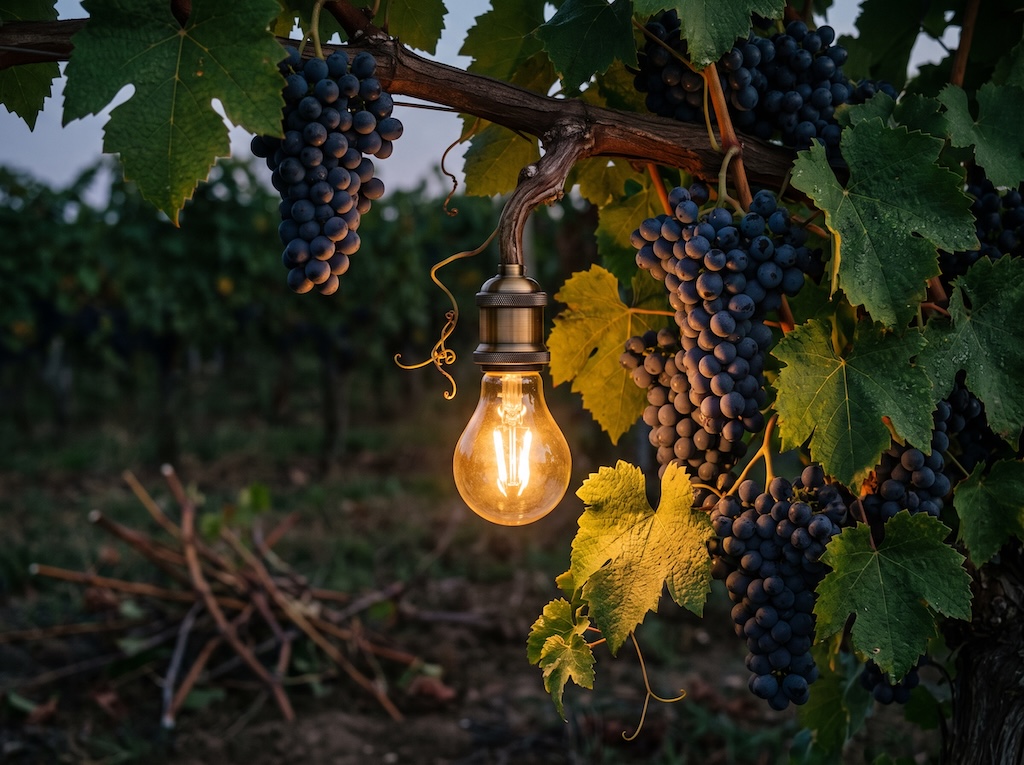
Imagine a 10-watt bulb on the ground in the middle of a power station, surrounded by billions of watts of power. If it isn’t connected, it stays dark.
Being near power isn’t the same as being connected to it. You can sit in church every week and still be that bulb.
“Apart from me you can do nothing.” Not a little. Nothing. It’s not that we have a small amount of power. We have none.
It’s not to treat God like a utility company we draw power from. The branch doesn’t harness something from the vine. It lives from it. The power isn’t a separate thing God hands over. It’s his life flowing through ours by his Spirit.
And what power. Paul prays in Ephesians 1:19-20 that we’d know God’s “incomparably great power for us who believe”. The same power that raised Christ from the dead.
Don’t we want that?
One more important part to remember… Prayer is only possible because Jesus made the way. He died for our sins on the cross and cleared the path to the Father. The power of the resurrection is available to us. Prayer is how we stay plugged in.
It’s just a conversation
I hear it a lot. “I’m not good at praying.” “I don’t like praying in front of people.”
We get it. We were exactly the same, still are. But we overthink this. We assume our words need to be perfect. That we need a script.
You don’t prepare what you’re going to say to your partner or your friends. You don’t need to with God either. That’s what the Holy Spirit is for.
And if it’s a relationship, our prayers should sound like one. Not just a shopping list. We’re very good at “I want this” and “why can’t I have that”.
Verse 7 is worth reading slowly: “If you remain in me and my words remain in you, ask whatever you wish, and it will be done for you.”
Notice the “if”. This isn’t a blank cheque. Prayer isn’t us talking Jesus into our plans. It’s his words living in us until our wishes start to sound like his.
If you’ve been with someone a long time, you start finishing each other’s sentences. It’s not mind control, just time together. Talk to God many times a day, the way you’d talk to the people you love, and prayer becomes instinctive.
Scripture is full of powerful prayers. Here are three you might not have noticed.
Nehemiah (Nehemiah 2:1-5). The king asks what he wants. Nehemiah fires off a split-second prayer before answering. But chapter 1 shows he’d been praying about it for around four months. Prayer doesn’t need a set time and place. It can be a few words.
Hannah (1 Samuel 1:9-16). She prays under her breath, so quietly the priest thinks she’s drunk. It doesn’t need to be polished sentences. God knows our hearts. He cares more that we’re looking to him than about the words we choose.
Elijah. Most of us know the story of the rain stopping and starting. Big, public miracle. But look what James says about it: “Elijah was a human being, even as we are” (James 5:17).
No better. No worse. Just like us. Our problem is we read these stories and assume it won’t happen to us. But the power of God is there for us too. The more our will lines up with his, the more we’ll see it.
The prayer Jesus gave us
So what does this look like in practice? Start with the best example we’ve got. The one Jesus taught us himself – The Lord’s Prayer.
It’s a prayer, but it’s also a model. It starts by honouring God. Think about it. You get home at the end of the day and the first thing out of your mouth is “Where’s dinner?” That’s not a recipe for a healthy relationship. You connect first. “How are you? How was your day?” Same with God. Connect first, then ask (not that you ask God how is day was!)
Here’s a walk through it. Don’t just recite it. Think about each line.
Our Father in heaven. “Father” is family language. And it’s the same Father as the gardener in John 15. The one we pray to has been working on us all along. “In heaven” keeps the balance. Close enough to call Father. Big enough to be in charge.
Hallowed be your name. We ask that God’s name be treated as holy. Outside the church doors, the name of Jesus Christ is probably the most abused name there is.
Your kingdom come. Our first request isn’t about us at all. We long for the day God rules here too.
Your will be done, on earth as it is in heaven. The same thing Jesus prayed in Gethsemane, the night he was arrested.
Give us today our daily bread. Provision for today. Like manna in the wilderness, you can’t stockpile it. It’s not a week’s supply and see you next Sunday.
Forgive us our debts, as we also have forgiven our debtors. We sin every day, so we need to keep asking. And it’s the only line Jesus comments on straight after the prayer (Matthew 6:14-15). He clearly knew this was the one we’d skip.
Lead us not into temptation, but deliver us from evil. Temptation is never far away. This is our guard against the drift.
For yours is the kingdom, the power and the glory, for ever. Amen. It ends where it began. With God’s name and God’s glory.
Notice… there’s no “I” or “me” anywhere in it. It’s our Father. Give us. Forgive us. We’re branches together.
Connected. Humble. Bold.
Three things to finish with…
1. Be connected. “No branch can bear fruit by itself” (John 15:4). Remaining takes effort, so prayer has to be part of the daily routine. Better still, part of who we are. Paul puts it simply: “pray continually” (1 Thessalonians 5:17).
Here’s a practical step. Pray the Lord’s Prayer every morning. Take a few minutes of quiet before the day gets busy. Say it slowly. Think about each line. Then keep talking to him through the day. The more he’s on your mind, the more natural it gets.
2. Be humble. Putting God first usually means putting our ego down. James is blunt: we ask and don’t receive because we ask with wrong motives (James 4:3). If we’re praying for our will to be done, we’ve got a problem.
Here’s a lovely detail. In verse 2 the Father “prunes”. In verse 3 the disciples are already “clean”. In the Greek, those are the same root word. And the tool? “The word I have spoken to you.” God’s pruning tool is his word. Let him shape you. Pride and stubbornness get in the way of that.
3. Be bold. “Ask whatever you wish.” The closer we are to God, the bolder we can be, because our prayers line up with his will. Pray for big things. Keep praying for big things. “If we ask anything according to his will, he hears us” (1 John 5:14).
Remaining in Jesus is less about getting what we want. It’s more about wanting what he wants.
The same God who lit the sun is willing to light you. But a bulb doesn’t shine because it’s near the power.
It shines because it’s connected to the source of power.
Leave a Reply